
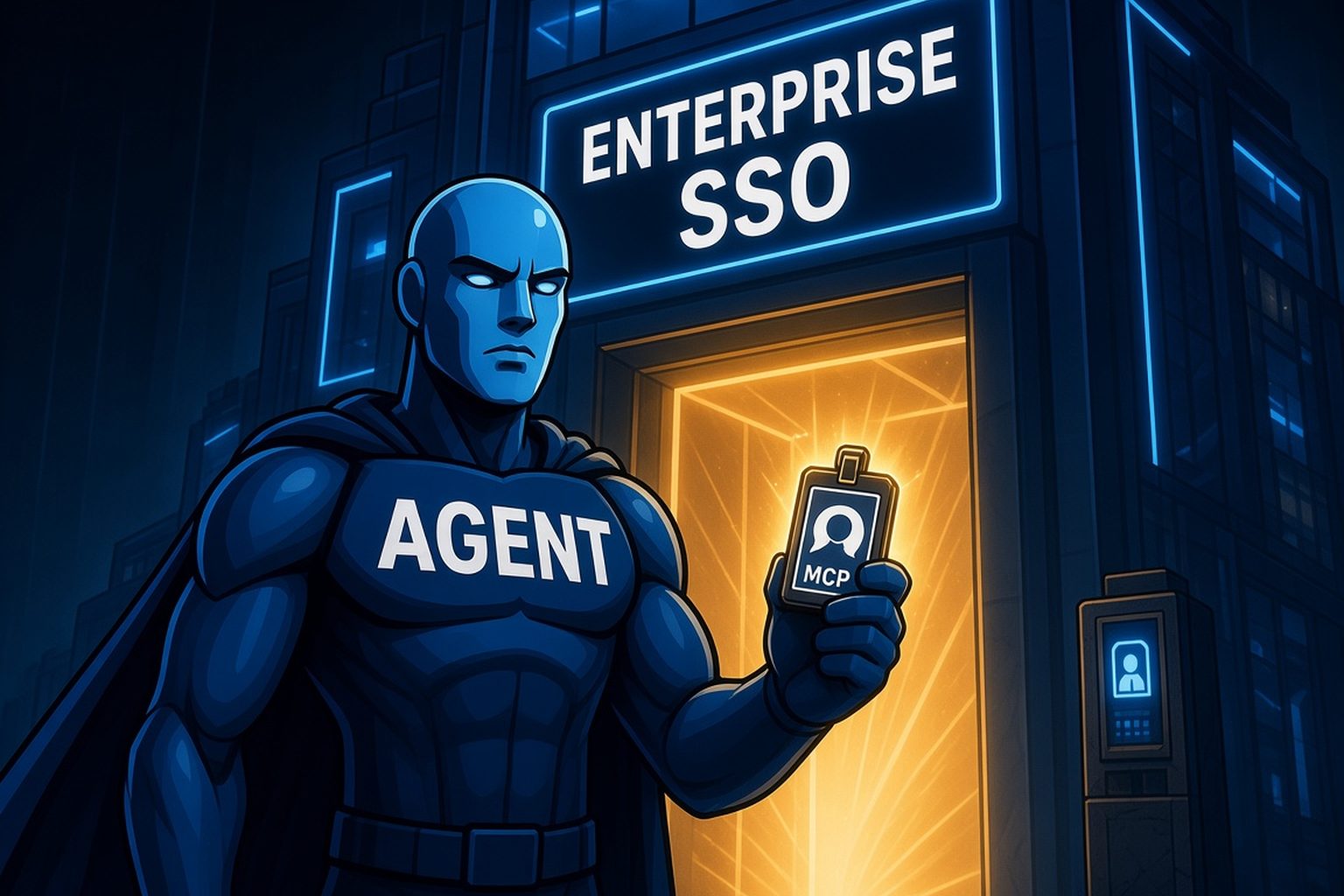
Picture an employee at one of your enterprise customers. Their AI assistant is set up by IT, they sign in with the company's single sign-on, and IT decides which tools the assistant can reach. Now they ask it to do something in your product.
Whether that works depends on more than having an MCP server. It depends on whether your server can accept access the way that company grants it.
What Enterprise-Managed Authorization does
MCP's Enterprise-Managed Authorization extension lets an organization control MCP server access centrally through its existing identity provider (IdP), so "instead of each employee authorizing each MCP server individually, the organization's IT or security team manages access policies in one place." (MCP docs)
The flow works like this. The employee signs in to their AI assistant through company SSO. When the assistant needs your server, it asks the company's IdP for a special signed token called an ID-JAG (Identity Assertion JWT Authorization Grant). It then trades that token with your server's authorization server for an access token. The user isn't sent to a separate sign-in page for your product. (MCP docs)
The ID-JAG itself is still an IETF draft, and the docs note that vendors track different draft revisions. (MCP docs)
Who supports it today
The MCP docs now include a table of products with public documentation for the flow. There are 12 of them, and they fill one or both roles: issuing ID-JAGs (the customer's IdP) and accepting them (your server's authorization server).
- Issue and accept, available: Okta, Ping Identity (PingFederate 13.1 and later), Descope, Athenz, ThunderID, and the Janssen Project (2.2.0 and later, off by default).
- Accept only, available: Stytch and AuthPlane.
- Accept only, early access or experimental: Auth0, WorkOS AuthKit and Scalekit (early access), and Keycloak (experimental).
On the server side, Cloudflare's workers-oauth-provider (experimental) and FastMCP 4.0 and later (beta) can also accept ID-JAGs. (MCP docs)
The docs say the list "records documented support only, so a missing product or an empty cell does not mean that a role is unsupported." So treat it as a starting point, not a verdict.
Why this is a sales problem, not just an auth problem
Enterprise buyers already require SSO for the people using your product. Agents are next. If a security team has set up its IdP to decide which agents can reach which tools, and your MCP server only supports one-off, per-user sign-in, you're asking every employee to work around IT's policy. Many companies won't allow it.
Supabase is an early example of doing it the other way. Its implementation lets an organization's IdP issue ID-JAGs for Supabase's MCP server, keeps access scoped to what each member can already see, and requires an admin to approve each MCP client once. (Supabase docs)
If your product isn't reachable through the path a company's IT approved, its agents will reach for whatever is. That's ghost churn at the account level: the seats stay paid, but the work moves elsewhere.
What to do this quarter
- Ask your top enterprise customers which IdP they use, and check it against the table in the MCP docs.
- Check your own auth stack. If you already use one of the providers that accept ID-JAGs, find out what it takes to turn the feature on.
- Keep the normal OAuth flow for everyone else. Enterprise-Managed Authorization is opt-in, and clients have to support it too.
- Scope tokens to the user, so an agent can never do more than the person it's acting for.
See where your product stands
Our free Agent Readiness Check scans your site for the signals AI agents look for and gives you a score in about a minute.